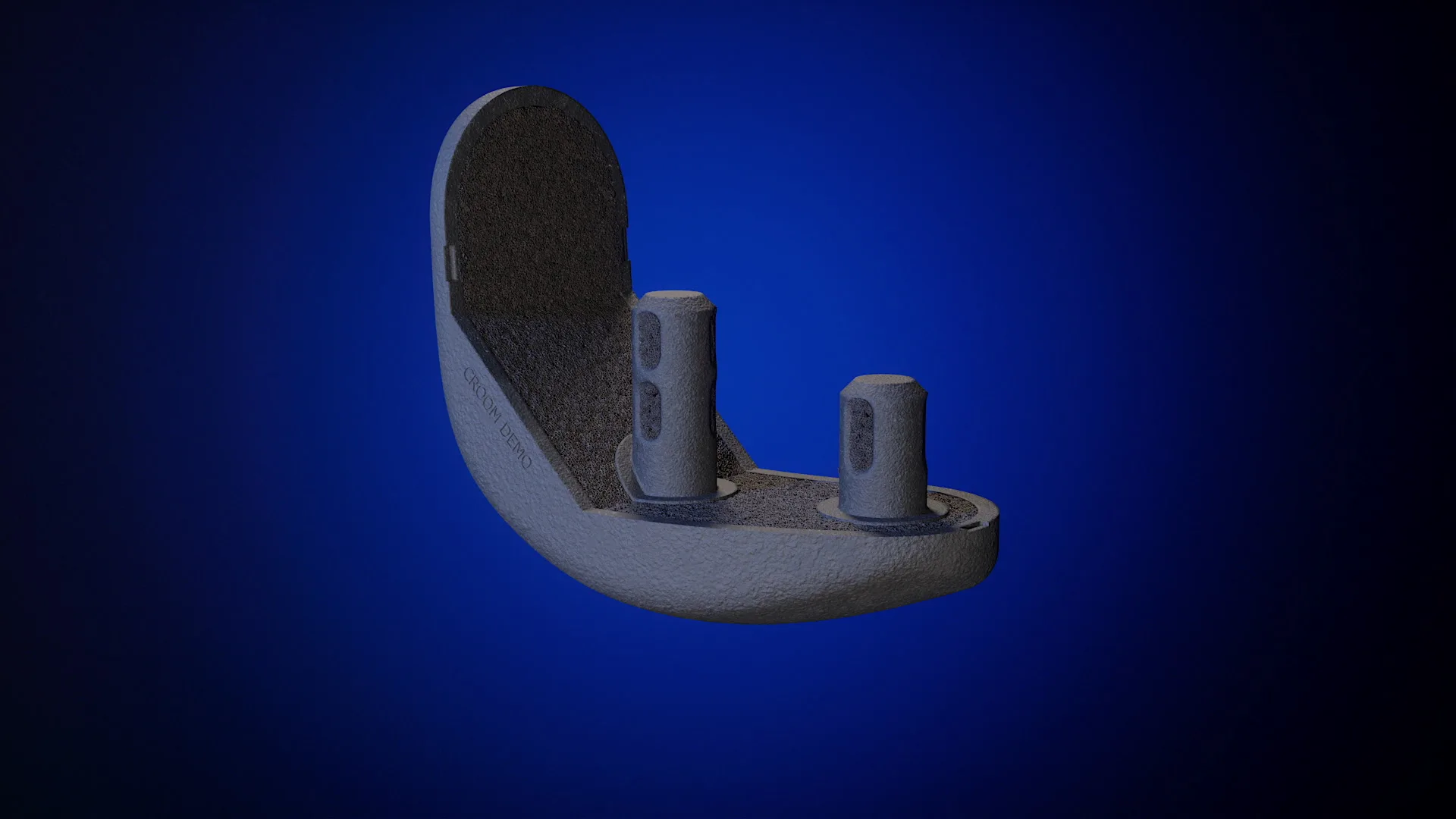
Croom Medical’s BioFuse film offers a closer look at a manufacturing approach that makes the porous structure part of the implant build. For an OEM developing a component with targeted porous regions, the important questions begin with the geometry: where the lattice is needed, how it connects to the solid structure and how the finished part will be assessed.
BioFuse uses laser powder bed fusion to integrate dense and porous regions within the same component. It gives engineers a way to discuss the lattice as part of the overall design, including the size of its pores, the proportion of open space and the transition between regions.
Designing the porous region
A lattice is a three-dimensional network, and its design involves more than selecting a surface texture. The arrangement of the network determines where material is present and how the open spaces connect. Changing one feature can influence the others, which makes the intended application the starting point for design discussions.
BioFuse supports tailored lattice structures and targeted placement within implant geometries. Croom Medical’s published examples include knee components, acetabular cups, revision cones and interbody cages. These examples illustrate the range of geometries that can be discussed; the requirements of an individual device determine its eventual design and manufacturing route.
Connecting the design to the manufacturing process
Producing dense and porous regions in the same build brings lattice design and component manufacture into one process. The engineering team can consider their connection while developing the overall geometry.
For the development team, this brings the geometry and the process into the same conversation. Features need to be considered in relation to build orientation, support strategy and the operations that follow printing. A design that looks appropriate on screen still needs a practical route through manufacture, inspection and handling.
This is where the wider manufacturing capability matters. Croom Medical’s additive offering connects printing with engineering support, machining, surface finishing, cleaning and material testing. The sequence is developed for the component and the agreed requirements, rather than assuming that every lattice or implant should follow an identical process.
Building evidence around the component
The choice of porous architecture also needs a corresponding plan for assessing the result. Dimensional information, surface characteristics and material behaviour answer different questions, and should be considered together when developing the manufacturing route.
Croom Medical’s on-site materials testing and inspection resources support this work. The objective is to connect the intended geometry with evidence from manufactured components, so that development decisions can be made on a clear technical basis.
See BioFuse in context
Explore the BioFuse platform. To discuss a component or a new porous implant programme, contact Croom Medical’s team.