


From an implant drawing to a first build
On a sacroiliac fixation screw, the difficult feature was a temporary one. The screw needed supports to hold its shape during metal 3D printing. The team also had to make sure those supports could be reached and removed from the finished part. Working with a spine OEM, our engineers changed the support design, investigated heat build-up and adapted the lattice. They went on to validate builds containing more than one screw configuration. Read the SI fixation screw case study.
That is where our R&D team comes in. A drawing sets out the geometry. A first build shows where the part distorts, where a tool can reach and which surfaces can be inspected. We use those observations to agree the next design change or test with the OEM.
Materials testing in Limerick
We choose the test to suit the decision. Tensile and compression tests show how a sample responds when it is pulled or compressed. Fatigue testing examines how it behaves under repeated loading. Microscopy lets us look at the region that failed, or compare a printed feature with its intended geometry. Together, those findings help the team choose between materials, adjust a process or repeat a build with a specific change.
Explore the Materials Testing Laboratory · See our rapid prototyping capabilities · Explore product and process design
Two technologies that grew out of Croom R&D
TALOS™ and printing tantalum onto titanium
Tantalum’s high melting point makes it demanding to process. Our R&D team worked with Global Advanced Metals to develop a laser powder bed fusion process for tantalum. One route prints tantalum directly onto a titanium substrate, allowing engineers to put a porous tantalum region where the design calls for it and retain titanium in the body of the component. This collaboration became TALOS™.
Explore the TALOS™ process · See porous tantalum research samples
Biofuse™ and the geometry of a porous implant
Biofuse™ grew from our team’s work on lattice design. The engineering question was how to build an interconnected porous region into an implant while keeping adjoining features solid. With laser powder bed fusion, the dense and porous regions can be printed in the same build. Engineers can vary pore size, porosity and the transition between regions to suit the geometry of the component. Explore Biofuse™ lattice technology.
Bioabsorbable polymers for braided sutures
In an Innovation Partnership with University College Dublin, we explored bioabsorbable polymer fibres for braided surgical sutures. The team screened candidate materials, extruded fibres, made trial braids and studied how the polymers degraded over time. A material that looks promising on paper still has to form a consistent fibre and survive braiding. This was a materials feasibility study. Further testing would be needed to establish how a finished device performs.
Collaborative research projects
An early EUREKA collaboration led by Irish Manufacturing Research gave Croom a way to help steer and test additive manufacturing research as an implant manufacturer. Later projects took that work in different directions, from monitoring a build in progress to measuring what happens at the cutting edge. Read the Horizon Europe Ireland account.
DIGITbrain · Reading a metal build layer by layer
In DIGITbrain Experiment 7, Croom supplied a metal powder bed fusion use case. The partners investigated whether a digital twin could use build data and images to flag an unusual layer while a part was still printing. For an engineer reviewing a build, the value is knowing where to look and what to compare with inspection of the finished part. Read the DIGITbrain experiment.
COGNIMAN · Removing supports and finishing printed parts
After printing, a robot must locate the actual component, reach its supports and follow the surface as the geometry changes. Croom supplied the implant manufacturing use case for this research. Project partners developed the FlexiFinish robotic demonstrator around those challenges. See the COGNIMAN demonstrator.
SPRINT · Measuring cutting forces at the machine
During a SPRINT trial on Croom’s Willemin-Macodel 508MT, an instrumented turning tool measured the force on its cutting edge as it machined a part. The live trace let the team see when the load changed during the cut. Watch the cutting trial.
NOMAD · Printed titanium structures for dental research
Croom contributed design and metal additive manufacturing expertise to NOMAD, a European research collaboration investigating biomaterials for dental implants. Our role focused on the components, including complex printed titanium structures. The consortium is studying how materials at the implant surface might help prevent infection. Read the NOMAD project brief.
ADDI-OPTIMISE · Controlling contamination in metal printing
Powder moves through several handling, cleaning and recovery steps in a metal printing process. Croom led ADDI-OPTIMISE to investigate how to identify foreign particles and improve control of that process for regulated components. Read the ADDI-OPTIMISE project brief.
Work with our R&D team
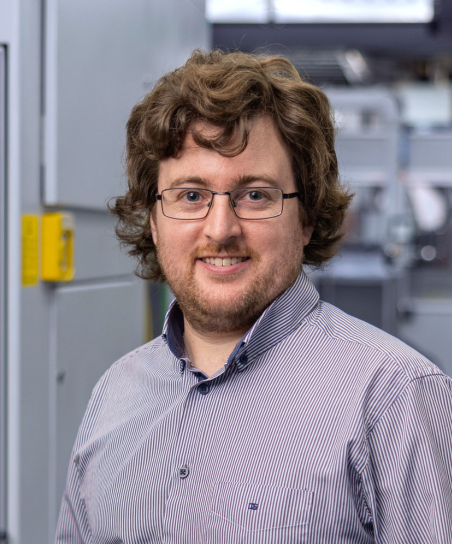
Dr Shane Keaveney
Shane leads R&D at Croom Medical. His work connects implant manufacturing in Limerick with research into printed metals, lattice structures and robotic finishing. Read about his research collaboration with UCD.
If you are weighing up materials, investigating a failed build or preparing a prototype, tell us about the component and the decision you need to make. A sketch, drawing or description of the feature is a useful starting point.